Rolling road Dyno’s are a fantastic way to measure the power of a vehicle.
However, they can also lead to many an unhappy and confused car owner as results can often be misread. Understanding the limitations, drawbacks and also benefits of a rolling road is essential.

Here are a few fundamental things you should know about rolling roads dyno’s
It is impossible for a rolling road to simulate real-world driving. Rolling roads provide a linear load on the engine. They do so with a slow pull from low RPMs to redline. It can take up to 45 seconds to reach redline. This amount of time and constant load on an engine and turbocharger will inevitably raise intake temperatures. Sometimes well beyond what the real-world driving will see. These temperatures will cause the engine to pull back the load values the ECU sees, thus limiting power.
It is very common for a car to have less rolling road performance. Yet maintain fantastic power on the road or track. This can be attributed to several factors.
The fan in front of the car is providing a linear flow of air. Usually to a small portion of the frontal area of the vehicle. Real-world conditions prove airflow is proportionately increased as speed is increased. This isn’t always replicated with the airflow on a dyno. The fans can also be too small to provide the same amount of air seen relative to the speed of the vehicle. This causes the air intake temperature to be well outside of what you will see in the real world. The higher these temperatures are the lower power output will be. The further these values are from the actual road conditions the less accurate the dyno run will be.
The issues with heat
Heat-soak occurs in both of the above examples. This happens when a car/engine doesn’t get adequate cooling for the given running conditions. The ECU will be forced to adapt to counter the additional heat. When a car suffers badly suffers from heat-soak the ECU will typically go into an EGT (Exhaust Gas Temperature) protection mode. Lowering the requested load value and increasing the amount of fuel to cool things down. This results in the curve tailing off much quicker than expected and a lower than realistic peak power output.
The majority of rolling roads will load a vehicle up during a power run in a certain way. This can vastly affect how the car ‘behaves’ on the rolling road as the ECUs are load based. All requests to the engine are calculated based on the feedback the ECU has from the engine and the load it’s under.
This doesn’t even take into account any potential issues that could be inherent with a car. The amount of heat already in the car before it goes on the dyno, or any inconsistencies between operators and rolling road calibration.
Flywheel or Wheel figures?
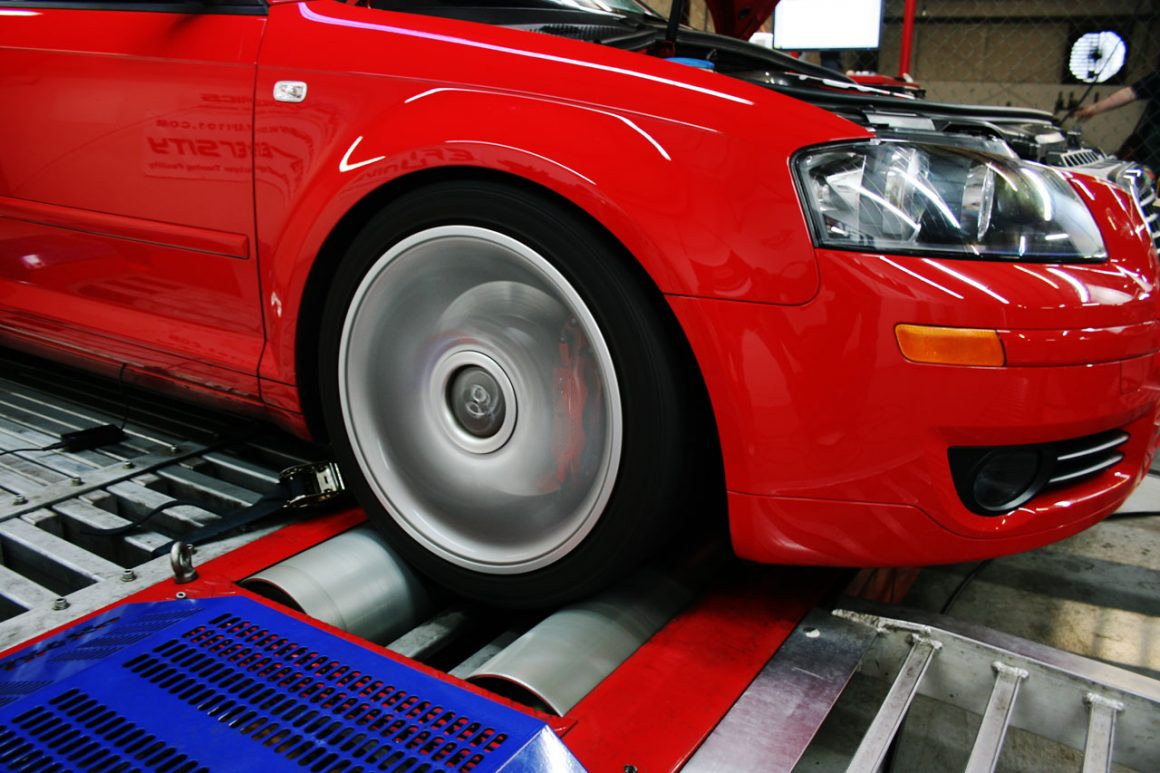
Wheel and flywheel figures can be a source of confusion. There’s a danger of back-calculating flywheel figures from a chassis dyno. Power at the wheels is more meaningful and fairly accurate so long as the ambient and intake temps are reasonable. Certain rolling roads calculate the force applied at the rollers. Everything from there on is a mathematical equation and as such don’t necessarily give you accurate figures.
Should we believe dyno numbers?
One of the biggest mistakes made is to take a figure given from a Rolling Road as gospel. There are so many varying factors between different rolling roads that can affect the output. Calibration, temperature, operator, tyre pressures, etc. That vastly different figures can be seen from one rolling road to the next. Realistically a Rolling road can be a great comparative tool to show differences additional components make. But in the guise of a rolling road ‘shoot-out’ for one-off reading. They can be a waste of time as a comparison tool. A figure or power curve only shows what the car is doing on that dyno, on that day, in those conditions.
Using a Rolling Road to show the difference between cars. Or show the increase from software can also be unrealistic without correct preparation. If you have two identical cars running the same quality fuel, tyre pressures, etc. You can still have a variable within the ECU due to different driving styles and conditions the cars see. One car might have been used much more aggressively than the other. Or have a much larger correctional factor due to adaptation from excessive heat. This can vastly affect the power output of a vehicle. Something else to be aware of is after programming an ECU the car will take a certain period of driving time to adapt. This period of time is dependant on driving style and conditions.
On-Road development
The Revo R&D department spends hours on the road, track and rolling roads during development. Ensuring it’s already been tested and proven in-house before public release.
What is important is a road test and inspection of the vehicle before it’s flashed/remapped. All Revo Dealers will check over your vehicle to see if there are any obvious issues that need addressing prior to Revo software being installed. You can find out a lot more about the Revo Global Development Programme at onlyrevo.com or here on the blog.
Peak Numbers
The peak numbers you get on a rolling road are typically referred to as ‘Pub Talk’ numbers; who has the most power and torque! In reality, the Peak numbers are largely irrelevant. It’s the power/torque throughout the rev range and the power delivery that’s important. The peak number gives very little information about how capable a vehicle is or how well it drives. Unfortunately, software sells on these numbers, without the real understanding of what they mean.
Peak figures don’t give an indication of drivability or even a true indication of increased performance. They ignore most of the RPM range and focus on a single RPM point. This peak dyno number also can’t tell you how smooth, powerful and efficient the power is delivered. Something essential to what makes a car more drivable and thus more enjoyable.
When Revo set vehicles up on the road, we are data logging and feeling how to car drives. Getting the most from the vehicle, for you the driver. It’s not just trying to chase a peak number
For more information about peak figures click here
